Turning Loops Into Songs
This blog aims to discuss turning loops into full songs. Covering some ideas, suggestions and practical tips for electronic music producers who want to make basic loops into full songs. Ideally, you will have a some grasp of the basics of musical production before reading this, the topics discussed are focused on developing a rough structure from a loop for electronic music and some specific practical techniques for breaking out of the loop. With most advice around this kind of thing, I am hoping that this could be a toolkit, not all of the suggestions will be good all of the time, but you can bring out the tools you need when they are applicable.
Ask Questions
Consider a loop that you have at the moment, and before you start arranging the idea, try to visualise some of the following things and jot down a few answers to the following questions.
- Where do you see this music being played? What location is this for?
- Who is in the audience?
- What time of day is this music for?
- How do you want the audience to feel?
- How do you want people to react?
- How would you want people to describe your track to others if they did not know the title?
- If this were a film scene, what would be happening?
If you can answer even just one or two of these questions, it should give you a clearer overall picture of where the music should go. Let’s think about some example answers for these questions.
Where is the music for? This could be a functional answer, such as the dancefloor, a music video, or maybe for people to listen to on headphones. It could also be a creative answer or fictional scenario, such as a den of space pirates looking for a crew in an intergalactic tavern (I would like to hear that, as currently, I am picturing the Cantina Band from Star Wars).
Who is in the audience? could be a crowd of younger ravers, or maybe older heads who have more discerning tastes and want a touch of the old school in the music. It could be for someone on their own as an individual listening experience. However, knowing the audience for your music can help you make choices about how best to present your ideas.
The ‘time of day’ question feels like it might not be so helpful at first, but this has helped me a few times. I remember one artist said they said their music is made for driving around the city in the early hours of the morning. This is going to give a different meaning to the music than something that is made for the daytime on a beach in brilliant sunshine.
I hope these examples give you a few ideas of things you could think about in terms of picturing the final piece. The negative side of this approach is that it can come across as ‘visualise it into existence’. This is not the case, I think that considering the bigger picture helps to make some of the smaller decisions a bit easier and clearer because now they have a context. Another negative is that sometimes thinking too much about the audience isn’t the right approach for everyone and every song. Some tracks are a bit more personal, and we need to look inwards. However, as is true with most music production advice, try the stuff you like, ignore the rest.
A Subtractive Process
When you have a loop that contains your core elements, one tip I learnt from a guy called Tony is to fill your whole session with the same loop for the full length of the track. Just take your loop and copy it for five minutes. The reason this works is that once you have taken this action, there is a clear problem to solve - the arrangement is repetitive. Now the direction for progress is clearly that you need to remove elements to create a basic layout. This is based on the principle that it is easier to reduce the energy in a piece of music than to increase it. This is also a good sign of progress, that instead of being stuck with a loop (an old problem), you are now faced with a much better problem… How do I make this arrangement highlight my ideas to best present them to the audience?
Mute the Drums
One tip I have found useful in electronic music is to group my song into three main parts. The drums, bassline and ‘musical elements’. Then for each of these parts, consider if you can make each of them interesting enough to listen to on its own for the whole length of the track. This is normally easy with the drums, but the really difficult stuff is to keep the bass part and music elements interesting for the whole song. EVEN IF THE DRUMS ARE MUTED. The reason this works is because it is easy to rely on the drums for energy and interest. However arrangement is also about developing the idea over time, keeping your listener listening. So if the music elements in their own right are good enough to listen to, and the bass elements are interesting now you just need to make them all work together over time.
Bigger Loops
When making new parts in the sequencer, some people only make loops that are eight bars. When you start making ideas with an instrument, instead of writing an 8-bar loop, write a 64-bar loop or longer. Try to keep your core idea, but also keep the idea interesting. If you write every part with much longer loops, you will have half a track done in almost no time. I was working on a collaboration recently, and the bassline was super simple and just repeated. However, the reason it worked is that it was played live on an analogue synth. My collaborator played the bassline loop over and over for the whole length of the track. That way, the small analogue imperfections and tiny fluctuations in the parts all keep the loop subtly changing and evolving just enough to keep it interesting.
Points of Energy
In dance music, there are some main sections or a structure that most songs have: Intro, Break/Build, Drop 1, Break/Build 2, Drop 2, Outro. This tip is about knowing where these points of energy are going to be and working in those locations in the DAW. To clarify more, this is more of a psychological trick. If you always start your track right at the beginning of the sequencer, try writing starting your ideas at bar 32 when you are writing drums or ‘drop’ elements.
If you know where the points of energy are going to be the greatest consider starting there. Don’t make the song at the beginning of the arrangement window, make the part for the place it is going to be, then you will have a different problem of filling in the gaps. To be clear what I mean is making a small change of starting your song at bar 32. It doesn’t seem like a big thing but, switching it up so that you can psychologically move either direction, left or earlier for the build and intro. Or more right and later to continue developing the idea. The downside of this approach is that I am not normally an advocate for ‘more choices’ in the music production process, but it is something to try to mix things up in your production. I also like to try starting at the end of the tune and working backwards.
A B Structure / 5 Descriptors
I learnt this trick from Mike Monday and have also seen something similar used by Jacob Collier. The idea with this technique is to develop more contrast in the music. When you have a loop and you are not sure how to develop the idea you can use the contrasting AB structure game. The loop you currently have is now the ‘A section’ of the music. Now you write down about 5 features of this loop, trying to describe the music and its sounds. For example the five descriptors could be:
1) Fast paced energetic
2) Complicated / complex
3) Bright / High Frequency abundant
4) Upbeat and positive
5) syncopated rhythms
Now that you have these five, the next task is to write an antonym or opposite for each of the descriptive words. For example the five opposites could be:
1) Slower pace or Half Time
2) Simple or Minimal
3) Dark / Low frequency focused
4) Melancholic and somber
5) Straight rhythm or 4/4
This second list of opposites is now the blueprint and plan for the next section you will write (we will call this the B section). To get your main musical structure you could switch between A and B for the whole song, or you could move them apart and try and create a section to bridge between them. There are lots of different fun approaches, but I like that this gives you a clear direction of where to go next. One downside of this, is that the sections can be jarring if they are too contrasting, so being sharp with your antonyms is going to be important to keep the song on track.
Make Different Loop Sizes
One cool way of making an interesting idea is by making different length loops for each of your parts. I normally keep my drum loop as 4 bars but some bass and music elements can be 3, 5 or 7 bars long, that way the different musical parts all tesselate to make a longer arrangement that naturally builds in variation and development of the idea over time. The negative of this is that the session can get a little bit messy and hard to follow if you do too many of the these different bar length loops so it tends to be beneficial to use this idea on simple, more minimal ideas.
A variation of this idea is keeping your whole track the same but starting one element, like the bass for example and moving it an 1/8 or 1/4 note later than normal, this can quickly add a new groove and feel to the music without having to make or add anything else to the piece.
Percussion Loops
Simple changes in percussion can help bring an 8 bar into a 16 bar with minimal effort. Shakers, Tambourines, Rides, Bongos, Congas are all viable sounds that can work. This also works great if you swap the percussion for an existing element (such as muting a fast paced hat). This has been a staple for the genre of drum n bass and house for a long time and works really well to initially get a short loop to be a bit longer but with minimal effort. The downside to this is that it can get a little bit predictable if you use this technique all of the time.
Use Songs You Love to Make a Template
Find a song that you really like, that is also in the style of music that you are writing. One cool technique is to import the song into the sequencer and make empty midi blocks to know illustrate when new elements come into the track. To take it to the next level you can also jot down a note of the function and purpose of each element. Now you can use this empty MIDI as the blueprint for your track, you will make your own drums, synths, leads, chords and baselines. The new tune will be your idea, however, the structure and arrangement template will be inspired by some music that you already know works well. The only negative I can think of is that it might be a bit time consuming to do this a couple of times, but after 2 or 3 times you will have a good framework for templates and not need to do it so often in the future.
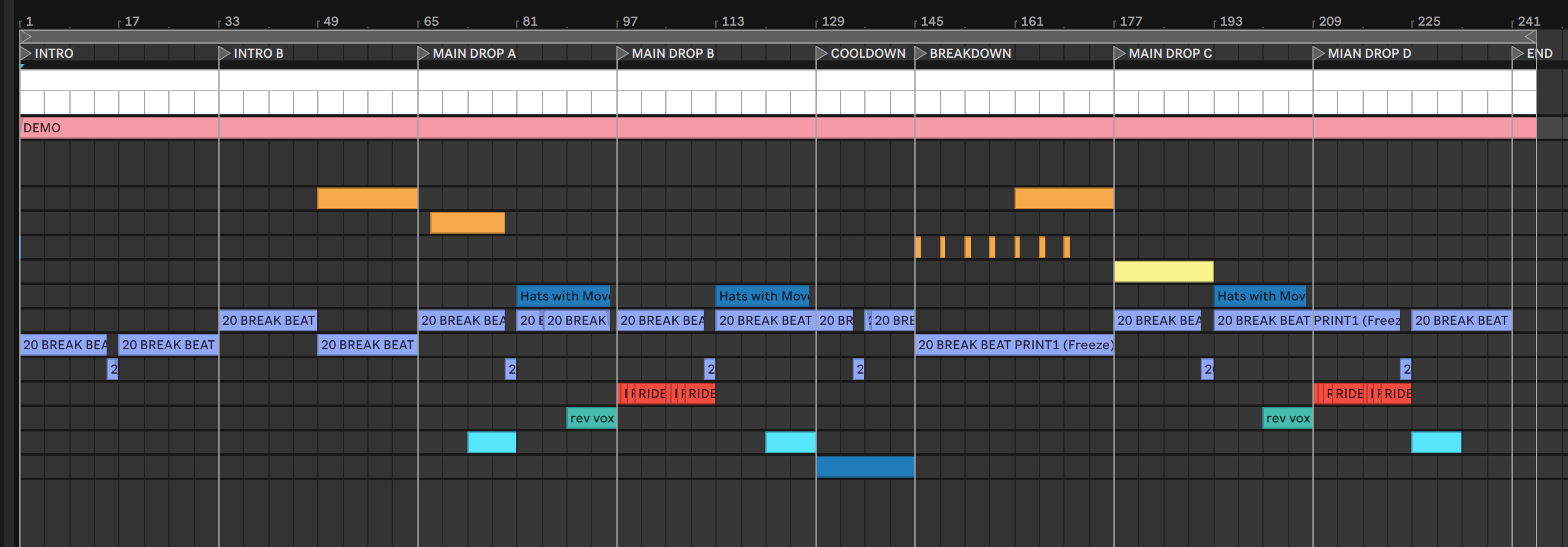
Here is an example of using a tune as a template, the demo track at the top and my layout copying the structure below. In this example I was only interested in doing it for the drums but I hope this clarifies the idea.
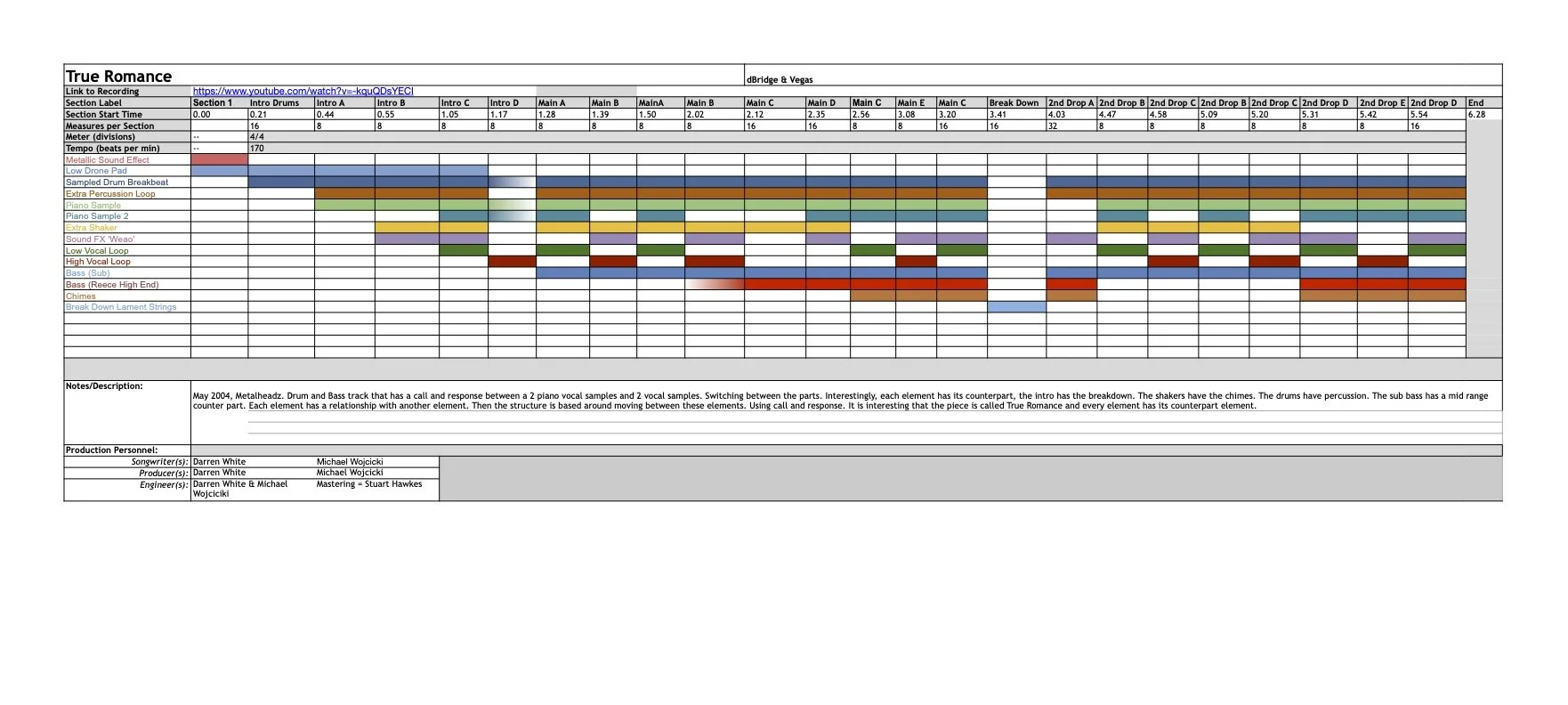
This is another example where I used a track called True Romance by dBridge to analyse structure and find out why it works so well. This time instead of mapping it out in a DAW I did it in a spreadsheet but it is a similar idea.
Mix Up The MIDI
This technique is quite straightforward and is looking to create space for ‘happy accidents’. I make a copy of my loop further down the session and I put all of the MIDI parts in the wrong places. The bass line might go onto the drum track, the drum MIDI becomes the melody MIDI. All I do is just shuffle them around dropping different MIDI parts in random places, just to see if some cool stuff occurs. It normally starts out quite chaotic, but there has been enough times where something cool has sparked an idea that I think it is a really beneficial technique to try. An adaptation of this is if you work primarily in audio, you can do the same but this time it will be the plugins and processing that change which can create really interesting timbres and ideas for sound design. The negative of this approach is that it relies on chance and randomness so the results can be varied. However, a great technique to have ready for the times where a little experimentation would be a good thing.
Don't Use Loops
It is hard to get stuck in a loop if you never use a loop, the loop button or a loop function in the first place. As a challenge, when you start a new idea, try turning off the loop function completely and not using it once in that session, don’t try and cheat by looping manually with a shortcut or some other workaround. Instead adopt the technique of through composition, or record everything in really long parts, however you go about it, no loop allowed.
Eno’s Oblique Strategies
There are lots of other producers out there who have had similar problems with getting stuck in a loop before you, so remember that you are in good company. Brian Eno came up with a bunch of prompts to shake you out of a creative rut, they are called Oblique Strategies. The techniques can be used for any art form and really help to change your perspective on what you have and how you could more forward. If you search online you will be able to find an online version or if you wanted you can buy a deck of cards to have to hand in the studio. I remember talking to someone who was writing a script and didn’t know what to do next, I mentioned Oblique Strategies and the one that came up was ‘Break the most important thing’, in this case it ment killing off the main character in the script and this allowed a whole bunch of new ideas and opportunities to flow. The downside to these is that they are quite obscure sometimes, so if you are more logical and technical the creative interpretation of ‘be like water’ can be baffling, me personally I live for that stuff.
Steal Some Classical Techniques
Retrograde = Playing the part in reverse order - use your DAW to reverse the MIDI for an instantly new part to make section 2.
Inversion = Changing the top-to-bottom relationship of the musical intervals. It’s a horizontal flip of the MIDI making a new part for section 3.
Retrograde Inversion = Flip and Reverse an idea. Instantly a new MIDI part for section 4 of your track.
Change The Time
If you are complete stuck, one classic technique for the second half of the track is to make it double time or half time. This is definitely a bit overused in some styles of music but the reason is because it works well. You can do this in a range of different ways but my favourite is by programming the half-time part by hand because it normally creates a bunch of space where new elements can come into play in the music.
Call & Response
Listen to your loop and if you have any parts that are playing in a continuous or consistent way, try splitting it onto two instruments. Make one the call and the other the response. Now when you edit the ‘call’ part of the phrase, the ‘response’ can be slightly different too if you wanted. Helping to create ideas that allow the track to develop naturally out of the loop.
Experimental FX Chains
On a new track at the bottom of the arrangement, try making a complex and experimental FX chain. You could consider adding things such as various delays, a flanger, chorus, phaser, distortion, etc. Then one by one, drop different parts of your song into this processing chain and bounce out the results, now you have a bunch of sounds that you can use to develop your idea. The negative of this approach is that you might end up with a bunch of audio that is no good that you need to spend time sorting through. However, after some experimentation with different chains of FX it becomes a bit easier to lock in the processes and FX that work for you.
Develop Your Chords
There are so many things you can do with a chord progression to keep your arrangement flowing and developing. Here are some cool things to explore around developing the chords in a song:
Inversions = This is where you change the vertical order of the notes in a chord, this can help to change the feel and develop an idea
Polyphony = (forgive my less than perfect explanation here) but the idea is to have three different synths all provide one voice of the chord. (Serum does the root note, Omnisphere does the third, Vital does the fifth). This helps with development because you can switch which synth does each part of the chord too.
Extensions = Add 7th or 9th’s to the chords to make them grow and develop over time in the track
Mute Things
One trap a lot of amateur producers fall into is keep adding to the arrangement over time. The whole arrangement is just adding a new element every 8 bars until the tune gets too full and they are stuck in a loop.. This can sound stale and linear. To improve this, remember to also remove or mute parts for progression. Arrangements will most likely need to get BOTH bigger and smaller at different times. The real trick is being able to manage the energy flow so that it creates the desired outcome for the flow of the track without being too jarring.
Make a Smaller Loop to Find New Ideas
This is another technique that is searching for happy accidents. To do this, use the loop function to select random points on the timeline to create a small one bar loop. The key to this working it to start the loop at different stages of the bar, 1/8th of the way in. This will re-contextualise where different parts are considered in terms of where ‘the one’ or ‘the first beat’ feels like it is, this can help to develop an idea by finding your section section hidden in a offbeat loop inside the first section.
Transitions and Drum Fills
Sometimes a track is just rolling well and all it needs is end of bar hooks, transitions and fills to keep the idea interesting. One example of an end of bar hook is the distorted bass edit at the end of the bar in a track called The Nine by Bad Company, there is a reason it is such a classic track, most of the time people are waiting for this moment to happen when they hear the tune. Transitions can be reversed sounds, builds, risers, filtering, reverb automation. However what they all have in common is that they create a moment of tension so that when ‘the normal section returns’ we feel a sense of release. The final thing for interest is adding classic drum fills, with bonus points for not always putting your fills at the end of the bar, try finishing them early, starting them late, middle of the bar etc to see what works for you. To keep these sounding good, try to remember the limitations of a real drummer, this will help to program realistic fills if that is what you are aiming for.
The Synth Jam
The final technique in this list for breaking out of the loop is to copy your loop for 3-5 minutes. Now grab some of your favourite synths and hit record on an Audio track. In realtime, play your synths over the top of the song, just jamming out ideas and making bunch of ideas. The aim at this stage is mainly to have fun and really try to perform and manipulate the sound over the length of the track. Once you have done a few recordings of different synths to create a bunch of 5 minute long layers, now you can cut up these audio files and arrange them around the underlying loop. Creating a rough structure with enough room for development over time.
Hopefully some of these tips will be useful to helping break out of the loop. My conclusion is that you need a bunch of tricks to make progress with an arrangement and not all of these will work all of the time. However, having something to try is better than just doing nothing and being stuck. I know that this movement away from certainty (the feeling that this loop is working) to uncertainty (I am not sure where it should go) can tough but after a while becomes a super fun part of the music making process and is an area that needs development as much as the skill of starting music. If you happen to use any of these techniques in your music I would love to hear all how you found it and what you made. It would be great if you could leave a comment to let me know your favourite from these ideas (if you had one).
