Exploring Michael Brauer’s ‘Brauerize’ Mixing Technique
This blog discusses Michael Brauer’s mixing technique which has been coined as ‘Brauerize the Mix’. This technique has multiple specialised bus compressors for subgroups of the mix. To differentiate this blog from other posts about this topic online, the aim will be consider ways that this could be modified for engineers and producers working inside the DAW and looking for ways to be a little more experimental in their process.
This blog builds on information from Tiki Horea who wrote about Brauer on the Sonarworks Blog.
Michael Brauer’s ‘Brauerize’ Mixing Technique Overview
To re-create the Brauer technique all of the individual multitracks for your mix such as kick in, kick out, snare top, snare bottom, guitars, bass etc (except lead vocal), will need to go to four subgroups. The subgroups are named A, B, C, D. You can think of them as the sub-mixes and each one has a different function or purpose.
A: Focuses on high-mids elements, if I was going to use this for Drum n Bass music or electronic music, this would be elements such as digital synths and percussion. B: focuses on the low end and foundational elements, such as drums & bass. C: focuses on midrange energy elements, such as Reese basses & Rip basses. D: Is for flowing elements, such as pads and FX returns. There is also an extra 1176 bus: This is used for when 1 or 2 elements need the ‘FET push’ sound.
The lead vocals however, go to their selection of compressors. So the vocal can go out 1) Clean, 2) Distressor, 3) 1176, 4) Optical 5) Tube Comp and 6) Optical Comp. The idea being that having all of these means you can find a great blend so that the vocal sits really well in the tune and can also be adjusted for different sections.
It is clear that the aim is to mix similar elements into the compressor groups for control, colour and cohesion.
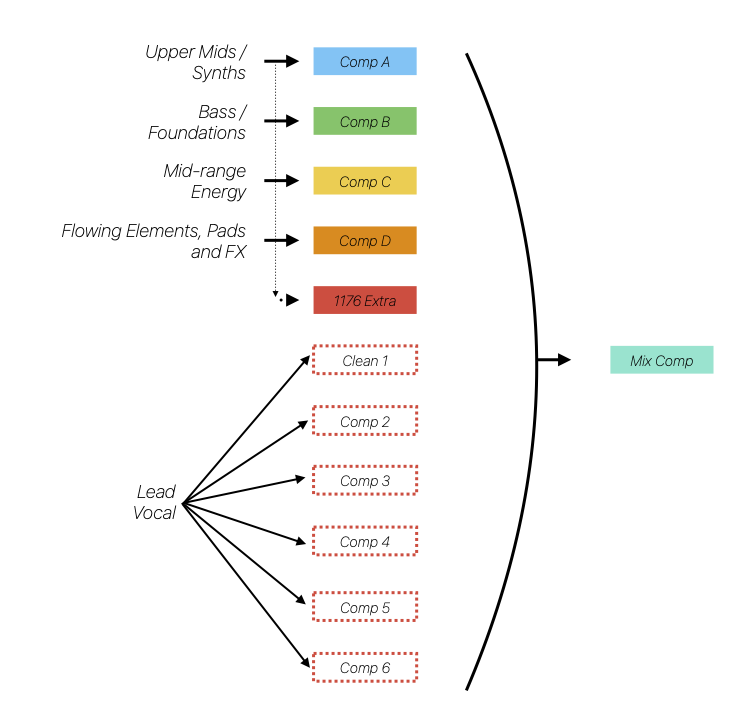
An image visualising Brauer’s Mix chain
Modifying the ‘Brauerize’ Technique - Clipping
For Drum and Bass music, there are a lot of similarities with the Pop/Rock music that Brauer works with, where this technique can really shine. Specifically, the density of both production styles can be quite similar at times. Also, how they both require energy, movement, clarity and control. The sub-groups allow each ‘family’ of instruments to be pushed and controlled. However, you get something similar to the clarity that comes with a HPF filter by removing the bass elements from three of the four sub-groups. This means you can compress a little harder without as many noticeable artefacts. It also allows the bass to get appropriate control, so when they all meet at the final mix bus at the end, there is less pumping but with good density and clarity.
To apply this to DnB, I think a range of different types of clipping on each bus could be an interesting way to modify the technique. For example, if your subgroups were A) Soft Clipping, B) Medium Soft, C) Medium Hard, D) Hard Clipping. This could be achieved with something like Freeclip from Venn Audio. The idea here would be that the drum, music, bass and FX elements could all be split into groups, and the different types of saturation could be applied for each. The Drums could get soft clipping from A, and provide a bit of gentle control, Bass can get hard clipping from D, for full power and weight. Then Music group could go to B and FX to C. That way, each group can be clipped in advance of meeting at the final mix bus. This is something that I am super keen to explore in the future.
One important note is that these types of techniques work because each part of the overall chain does a little bit of the processing. If everything is being smashed at each stage, it will all sound too flat, but a little bit of control at each stage can add density and control without overcooking the whole thing.
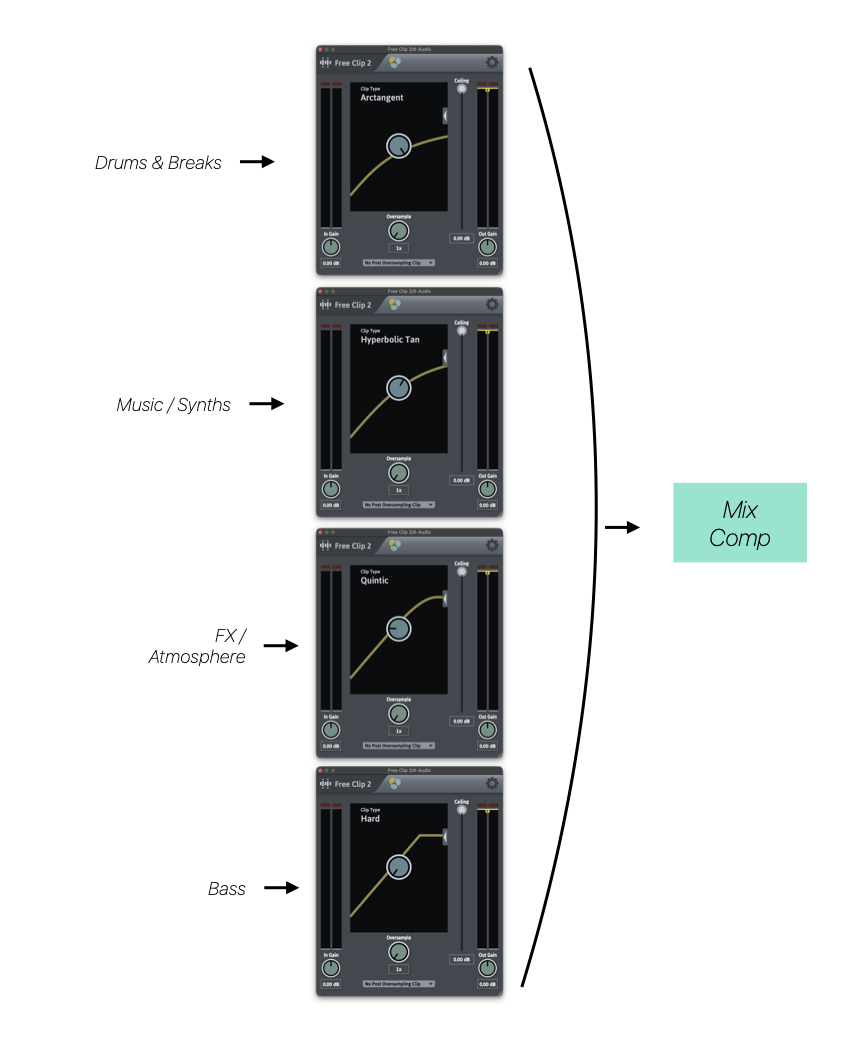
A clipping version of the multi-bus system - This is just one of the ways that this technique could be modified. It could also be with different saturators on each bus instead of clippers or compressors.
I would not recommend this with EQ sub-groups 😱
This kind of technique also reminds me of a mixing practice where you would have 4 sub-group mix busses that were specifically filtered so that they would one receive only A) High end, B) Hi-MIds, C) Low-Mids and D) Bass. Then instead of sending each instrument to the main output you would give it different send amounts to each 'frequency band’ subgroup. I wouldn’t recommend this technique at all, but it is interesting to think about how different elements of the mix can be compartmentalised for both control and clarity. I think the major criticism with this approach is that there is going to be serious issues with phase, a potential lack of cohesion between the parts and overall it is going to be time consuming and annoying to work with.
Overall I think that the Brauerize technique definitely has its place and you can’t argue with the whole host of records that Brauer has mixed and have gone on to be a commercial and critical success. However, not all of us can afford the amount of hardware and studio space that would be required. So most importantly I think taking some lessons from the technique is the best way I can progress at the moment. What I see as the main reason for this being so interesting is because instead of one thing dominating the final mix bus (normally the bass) each sub-group gets controlled before it hits the final mix-bus compressor with its own sub-group control. There is also pre-set options that allow for rapid mixing for example, if I need more push the 1176 grit bus is ready to go. My take-away from Brauer is to keep things under control before they hit the mix bus and also have some group/bus options ready to go in advance for groups that have different requirements.
If you have any modifications that you use based on this technique I would love to hear about them in the comments. Also you can send me your music for feedback, for example if you used this technique on a mix, I would love to hear how it turned out.

Track Feedback for Producers
Do you want honest, helpful feedback on your music? I offer personalised track reviews for electronic producers of all kinds, with a special focus on Drum & Bass. Whether you’re stuck on a ‘work-in-progress’ beat or polishing a nearly-finished tune, I’ll give you clear, constructive feedback and advice on things you can try to help you improve and grow as a music producer.
You can choose what kind of feedback you’d like:
Production & Mixing – Tips on sound design, EQ, balance, and overall technical feedback.
Musical & Creative – Thoughts on arrangement, flow, vibe, and how your tune connects with an electronic music fan.
Full Feedback – A mix of both, for well-rounded guidance.
The goal is simple. To give you useful, no-fluff feedback that you can actually apply to your music.
How feedback is delivered:
You’ll get your feedback in the way that works best for you — either written notes via email (FREE), a video walkthrough breaking everything down step by step, or, if you prefer something more interactive, we can also arrange a live call for real-time discussion.
Please note that both video feedback and video calls online are paid services.
Why work with me?
I’ve been immersed in audio and music since 2004, and I currently lecture at two London universities alongside my work as an artist, tutor, coach, and audio engineer. My background includes:
Over a decade of teaching experience (PGCE, QTLS, AFHEA qualified)
A Master’s in Electronic Music Composition and a BA (Hons) in Music Technology
Music signed to leading Drum & Bass labels such as Metalheadz, Dispatch Recordings, Flexout, Subtitles, Sofa Sound Bristol, and Fokuz Recordings — with airplay on BBC Radio 1, BBC 1Xtra, BBC Asian Network, and Noisia Radio
Mixing experience across genres, from Pop and Hip-Hop to Folk, Foley, and of course Drum & Bass
At the core, my aim is to give you useful, down-to-earth feedback that helps you develop your sound and move forward with confidence.
Delivery time for the feedback will depend on the amount of work I currently have and also the details of the song/project.
You can expect a response within 1-2 working days when purchasing this service.
Matt Chapman12th December 2025