Making More Time For Music
This is as much a blog post for myself as it is for everyone else. Recently I found myself not making time for music and I noticed that my output was slowing down. This is my roadmap to getting MYSELF back on track and I hope it helps you too as I work through some of the things that I have already put into place and some of the things that I will implement in the future.
Photo by Alexandre Debiève on Unsplash
Establishing Priorities
I am assuming that most of the people reading this have a bunch of responsibilities and also interests that pull on your time. Some things are important and essential to maintain. For example, non-negotiables for me are faith, family, friends and finances, if these aren’t sorted I don’t tend to have the room in my mind for creativity. Getting non-negotiables sorted first gives the metal space to be able to be creative.
Then there are secondary positives that draw on time. So many hobbies can be a draw on time such as learning to speak another language, learning to draw, playing chess and many other things that are too numerous to list here. These things are good because they give new influences that can inform music and also help to keep the brain active and developing with new challenges.
Then, there are some time sinks which only have a small amount of benefit. These things normally tend to be shrinkable without too many negative effects. Such as, social media, flicking through TV (without watching something specific), getting stuck in a YouTube loop and any platform that allows endless scrolling. These are definitely areas that could be cut back and without too much of a negative impact and maybe even have a positive impact.
When I feel like I am lacking time, I need to remember what my main priorities are, and get them right first. Personally, getting music out into the world is one of my main priorities. This leads me to my first point, I find it much easier to remove things to make time. For example the ‘screen time’ function on my phone is a great case-study for time goes. There is probably two hours a week that could have been saved here easily to make more time for music. A less drastic approach can also be trimming things back, such as setting automatic time limits on the phone. This was my first step to getting more time for music.
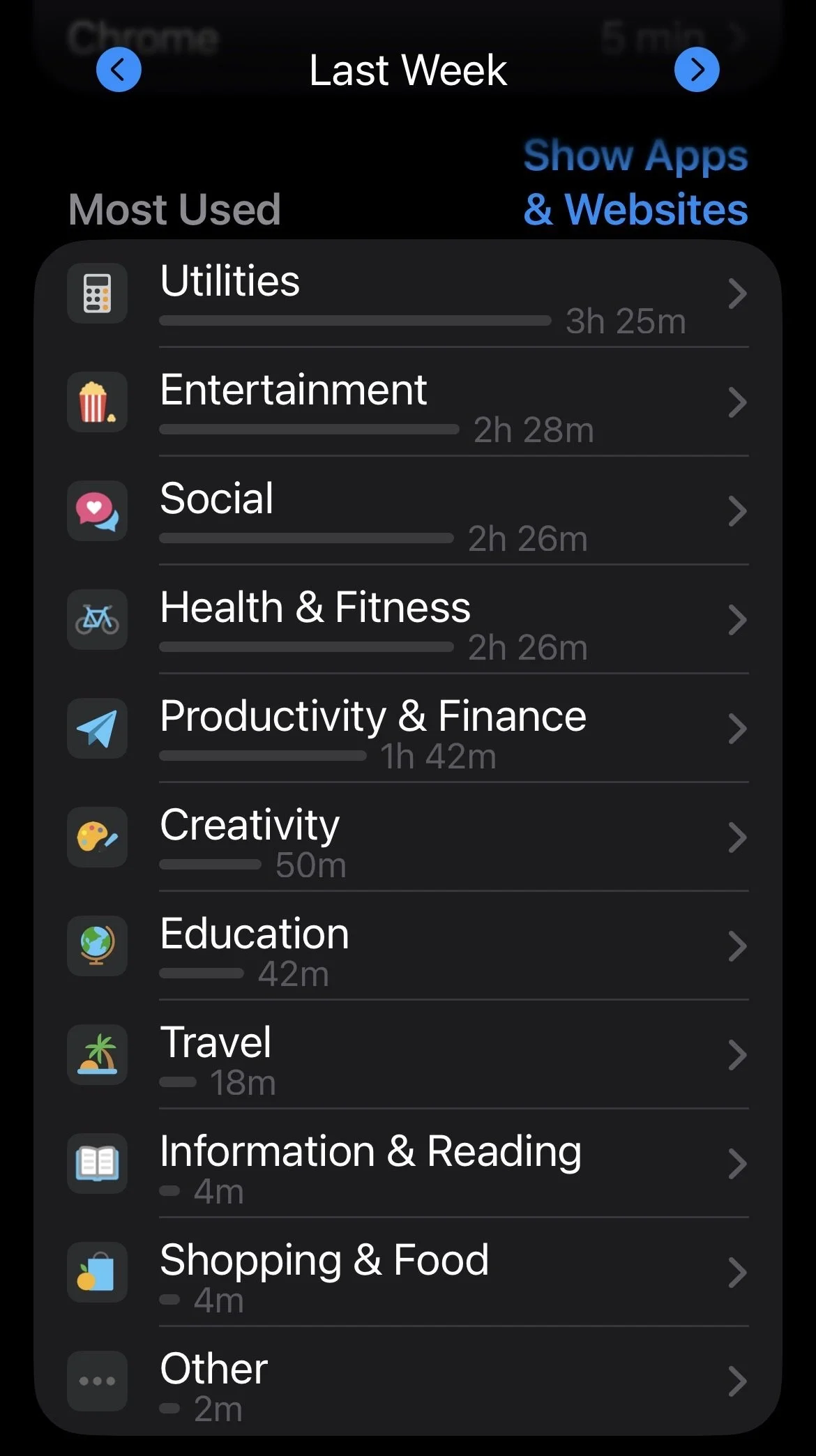
A snapshot of my screentime - some of this stuff was unavoidable, but there must be at least one or two hours a week that I could have stopped scrolling Reddit and made some music instead.
The second thing I did was to trim down some of my other hobbies to be a reasonable size. For example, I really want to learn all of the flags of the world and improve my geography knowledge, but if I am doing that whilst at home, when I should be prioritising music, then it is no good. However, whilst I am having my lunch break at work, instead of doomscrolling I could replace this with learning the flags of the world. The same with reading/audio books, doing this at home would be great, but it could also fit into my commute. So I think moving some of my hobbies to more appropriate times was another way to commit more time to music.
An important side-note here, is that it is also good to balance times of being entertained with times of boredom too. Let boredom be your companion sometimes.
Removing Distractions
Removing distractions is a big factor in making more music. The first thing I did was to stop my mac doing the notifications and pop-ups in the top right hand corner. Now this advice has a caveat, I can’t ignore life and essential notifications. If someone needs my help, this still needs to come through. However, a pop up telling you about something in a game, an item is back in stock or a software update - these things can generally wait until a time when I am not trying to do my important creative work.
On my phone I only allow a handful of essential people to contact me by using focus mode, so if there is an emergency of course I can still be contacted, but everything else goes to answerphone. Once again it is essential to balance responsibilities with your creativity. But there is also a difference between important calls, which you should answer of course.Then something which is unimportant such a notification that a product is on sale. So balance here is the name of the game, but anything reasonable that you can do to remove distractions will be a big help in having more time for music.
Time of Day
One of my fondest memories is a week I spent producing music with my pal Phil. We both tend to feel creative at different times so I would wake up early in the morning and start making tracks, then midday Phil would wake up, we worked together for a while until I went to sleep and he would do the night shift alone. This worked great because I focus in the morning and he locks in at night.
I need to remember that making music when I get home from work, doesn’t really work for me. I find it is best when I make music first thing in the day as soon as I can. However, my pal is completely different and needs a few hours to wake up and generally works way better late at night.
I have also noticed something quite small but it seems important, if I wake up and check social media first, getting on with creative things feels much harder. But if I just sit in the chair and get started, music (not always good) follows.
My summary here is to think about the time that is best for making music and experimenting. Also to consider what is happening directly before you make music to make sure it is conducive to creativity.
Clear Goals
Goals are good when they give you some direction. I also think without clear guidelines, I personally struggle. The difference is highlighted in the two statements below:
I want to make more time for music
I want to make music for 20 minutes a day in the morning when I first wake up
Number 1 is a nice dream, it is what I want to do, but without the specificity required to make something more likely to happen. Number 2 on the other hand is a little more effective because I have planned out the ‘when, where and duration’ in advance.
The second thing to clarify is the deadline, me personally I work much better knowing how much work I have to do and when it needs to be completed by. This is highlighted in the following statements.
I want to make music for 20 minutes a day in the morning when I first wake up
I want to make music for 20 minutes a day in the morning when I first wake up, to complete a 11 track album by April 30th.
This is another example where 1, is pretty good. However I think that 2 is a little better because it clarifies even more what my goals are. Now that I have this goal, all that is left to do is show up and make it happen.
Creating a Habit
I recently just listened (for the second time) to a book by James Clear called Atomic Habits (which I would highly recommended for anyone interested in self improvement books). This has been important for clarifying that I need to build a habit from small steps. He outlines four important things to make a habit stick - make them more obvious, attractive, easy and satisfying. So using these ideas with making music I can try the following things:
Obvious - I could load up the DAW session the night before, so that when I open the computer it is the first thing that I see.
Attractive - Once I have made music for 20 minutes, I can reward myself with something positive like an online game of chess.
Easy - This one is important to clarify that the practice of music has many challenges and these are important, instead this is talking about making it easy to build the habit. In this case I could focus on keeping my workspace tidy, having no mess or things blocking my path to sitting down and making music. Also another example could be having some templates to help get things started.
Satisfying - This takes care of itself for me, once I have made music I am happy that I took the time.
Support Network
Having a team around you can be really helpful for keeping on track with making music. I am not sure it is good to share my goals publicly (I am still making my mind up about this) but sharing goals with a friend who supports you can be a great to progress your music making practice.
At different times I have made a pact with a friends to say that we are all going to make music and try to achieve a certain goal with an aim to keep each other accountable. This can be as simple as asking them to check in on you or arranging a date when you will meet and play each other what you make for feedback.
In the past I experimented with a public deadline read my blog post on the Noise and Sine LP and I might do this again becuase it did motivate me to get things done, however, I set such a short amount of time it resulted in some small compromises. However, it is one more album than I had before.
Templates
Having a template ready when you open your DAW can be really helpful for saving time and getting into the mindset for music rapidly. For example, I like to have a few instances of Serum 2, plus a few analysers ready on my 2-bus. This compounded over the years will save me a bunch of time rather than opening the same things over and over. Also on this same note, having chains of effects or channel pre-sets can also help to save a lot of time, for example in Ableton I have a group effect which filters a signal before a reverb and has a dry/wet control. This is a simple thing but it has saved me so much time.
The negatives some people say about templates is that they can sometimes make things a little predictable and negatively impact ‘unexpected’ ideas and creativity. I think this criticism is based in not having explored templates enough, because you can make them as functional or as unpredictable as you desire. You can also create a bunch of them over time to have lots of different options to choose from.
Personally I think that templates should evolve and grow over time with small updates each time you notice that you are repeating an action manually and frequently that could be saved or automated in someway by presets or templates in the DAW.
Conclusion
Hopefully this has helped give a few ideas about how you might be able to make more time for music. If you want someone to be accountable to for making time and finishing some music then you can book a tutorial with me and I will hold you accountable to getting some stuff finished and give some advice along the way.

This is for 1-to-1 online Music Production Tuition.
It will be an online session where my screen and audio will be shared with you, and the session will mainly focus on demonstrating music production, skills, techniques and ideas using Ableton Live (Logic Pro and Pro-Tools can also be requested). However, it doesn’t matter what DAW you use. The session(s) will focus on the ideas and principles behind the techniques as well as DAW specific ideas. However, DAW specific sessions can be arranged.
If needed, I can record the call as a video, so you get a copy to watch back after the session.
I am a university lecturer during the day, so evenings and weekends are times when I can be free (also happy to do super early morning sessions too). My time zone is GMT/UTC. However, we can make it fit around your schedule as long as I’m also free.
In terms of what I offer, I make each lesson focused on one topic, or we can do a deep dive into a topic and split it over multiple lessons if required. For example, if you pick 10+ hours, I can design a full program to suit your needs, and we could explore many factors of sound design or mixing. Below are some of the topics that are frequently requested, but the list is not exhaustive:
Synthesis, Sampling and Creative Processing
Drums Programming and Breakbeats
Building Ideas / Song Starters
Sound Design
Technical & Creative Mixing
Specific Plugins & Virtual Instrument Deep-dive
Advanced Electronic Music Production
Introduction to Ableton, Logic Pro, Pro-Tools
Arrangement Techniques & Breaking out of the loop
Basic Maths and Calculations for Music Production
Reference Songs, How to Reference and Analyse Productions
Sound Fundamentals
There is an option below to have a 15-minute online call with me to discuss what you want to learn and to see if this is something I can provide. Feel free to use this if you have any questions at all.
When you get to the checkout, there will be a form that asks you a few questions. I want to find out a bit about you and listen to your music. I can suggest some areas to work on or options for your lessons.
My background is both a Music Artist and a Teacher. I have been teaching since 2011 and have a PGCE qualification in education. I have also been making and releasing music for about the same amount of time. However, despite all of this, my approach to learning is collaborative and looking to help each other develop.
Hopefully, this tells you enough to get started. If you are still unsure, you can check out my testimonials or see the FAQ area to read more.
I am looking forward to working with you.
You can expect a response within 1-2 working days when purchasing this service.
